
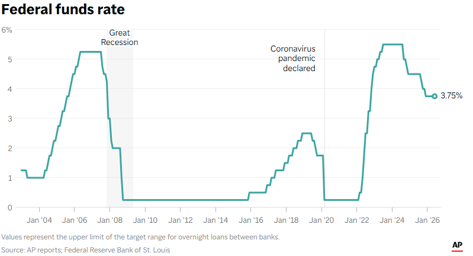
Last week, the Federal Reserve voted to leave the federal funds rate unchanged at 3.75%, where it has remained throughout 2026. While the broader trend since early 2024 has been toward lower interest rates, recent inflation data has led many members of the Federal Open Market Committee to take a more cautious approach before implementing additional rate cuts. Leading up to the meeting, markets debated whether persistent inflation pressures might even prompt the Federal Reserve to take a more aggressive approach and reverse course, raising the federal funds rate.
Inflation Remains the Key Story
One of the Federal Reserve’s primary responsibilities is maintaining price stability while promoting maximum sustainable employment. It accomplishes this by adjusting the federal funds rate to influence economic activity. Lower interest rates generally encourage borrowing, spending, and investment, while higher rates help slow demand and reduce inflationary pressures. The challenge is finding the right balance by providing enough support for economic growth while keeping inflation under control.
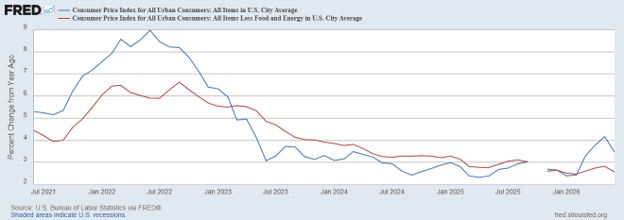
Although inflation has declined significantly from the highs experienced over the past several years, it remains above the Federal Reserve’s long-term target of 2%. More importantly, inflation has not followed a perfectly straight path.
After rising earlier this year, inflation data showed improvement, with headline inflation easing back to 3.5% in June. Much of the recent volatility appears to have been concentrated within the more variable food and energy categories, while underlying inflation trends have remained comparatively more stable.
Why are Rates So Important?
The Federal Reserve plays an important role in influencing economic conditions, but monetary policy is not an exact science. History provides several examples where the timing of monetary policy decisions proved challenging.
In the late 1960s and early 1970s, the Federal Reserve eased monetary policy as economic growth slowed, but inflation pressures later intensified. The result was a prolonged period of rising prices that ultimately required significantly higher interest rates to restore price stability.
More recently, in the mid-2000s, interest rates remained relatively low following the 2001 recession. While many factors contributed to the housing and financial crisis that followed, the period highlighted the difficulty of balancing economic growth, financial stability, and inflation risks.
The challenge is that the Federal Reserve is always attempting to manage a forward-looking economy with incomplete information. Acting too quickly can allow inflationary pressures to return, while waiting too long can unnecessarily slow economic growth.
This is why markets closely follow every inflation report, employment release, and Federal Reserve meeting. Investors are not only evaluating current economic conditions, they are trying to understand how policymakers interpret those conditions and what actions may follow.
The Ballast Perspective
Investing – Financial markets will continue to react to inflation reports, employment data, and every Federal Reserve meeting. While these events often create short-term volatility, they rarely change the long-term principles of successful investing. Rather than attempting to predict the Federal Reserve’s next move, we believe investors are better served by focusing on what they can control: maintaining a diversified portfolio, investing with discipline, and staying committed to a long-term financial plan.
Planning – We follow interest rates closely to help clients take advantage of opportunities created by changing market conditions. Whether evaluating cash balances, savings strategies, borrowing decisions, or portfolio positioning, understanding the rate environment allows us to make more informed financial decisions aligned with each client’s goals.
Want More?
Sign up for our newsletters and magazines here.
Contact
Visit ballastplan.com, call 859.226.0625, or e-mail info@ballastplan.com.
About Ballast
Ballast, an employee-owned financial planning and investment management firm based in Lexington, KY, specializes in providing tailored services to high-income earners, high-net-worth clients, and individuals/businesses with complex financial situations. Our team of fiduciaries proactively anticipates and solves your needs by taking the time to understand your goals, passions, and what truly matters to you and your legacy. Ballast is built for financial security by financial experts. You work hard every day. Let us take on some of the work for you.
Disclosure
Ballast, Inc. is a registered investment adviser with the SEC. Registration with the SEC does not indicate that the adviser has achieved a particular level of skill or ability, nor is it an endorsement by the SEC. All investment strategies have the potential for profit and loss. Ballast, Inc. is not engaged in the practice of law or accounting. Always consult an attorney or tax professional regarding your specific legal or tax situation. Any specific strategy or market/economic commentary may or may not be appropriate for your individual situation, may not have discussed all material implications of implementing said strategy, and may be reliant on data provided by outside resources. Before implementing any strategy or investment decision discussed in a Ballast commentary, please consult with the appropriate professionals to confirm the thoroughness of the strategy presented and its appropriateness for your individual situation.